Simulation & Analysis · 2026
Cantilever Bracket Structural Optimization
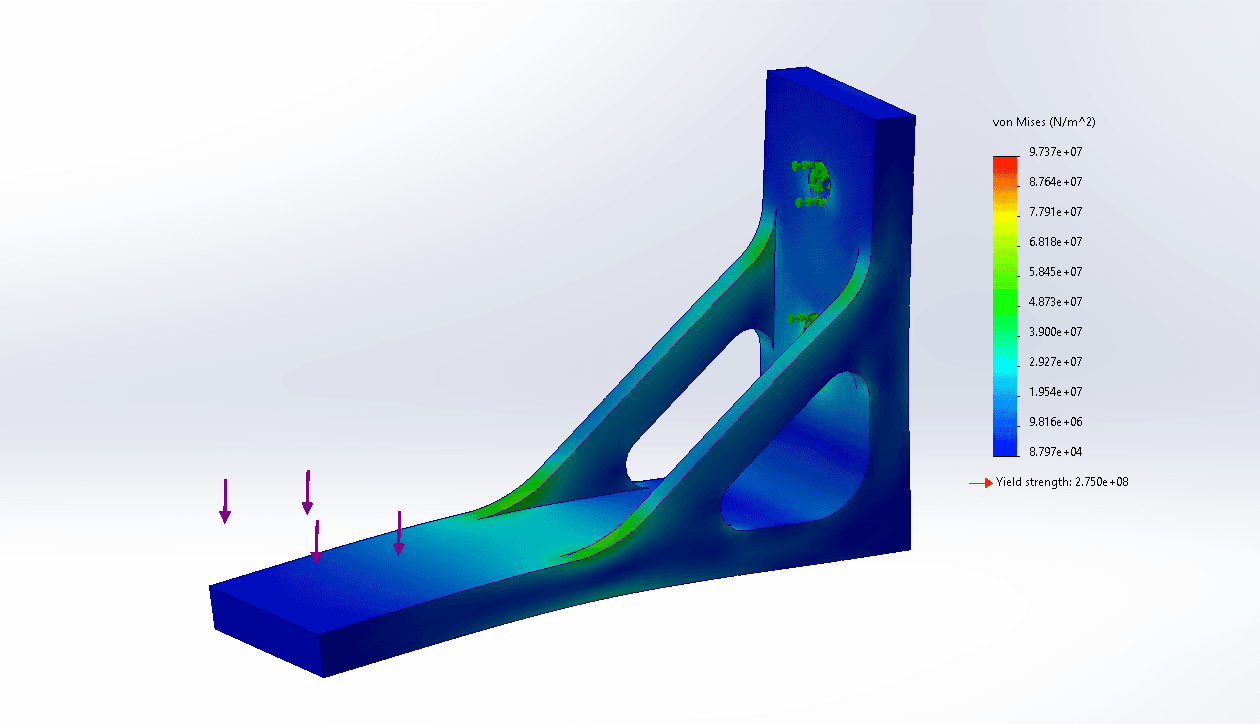
Used finite element analysis to redesign a cantilever bracket subjected to a 500 N load, increasing the factor of safety from 1.79 to 2.82 and reducing maximum displacement from 2.20 mm to 0.59 mm while minimizing added mass.
- Role
- Independent Analysis Project
- Tools
- SOLIDWORKS, SOLIDWORKS Simulation, Finite Element Analysis, Structural Design
- Timeline
- Completed
- Team
- Individual Project
01Objective
The objective of this project was to redesign a cantilever mounting bracket subjected to a 500 N downward load while satisfying two structural requirements: a minimum factor of safety greater than 2 and maximum displacement below 1 mm.
The design was iterated using finite element analysis, first adding material to improve stiffness and strength and then removing low-value material to reduce the mass penalty.
02Analysis setup
A linear static study was created in SOLIDWORKS Simulation. The bracket was modeled in aluminum with a yield strength of approximately 275 MPa.
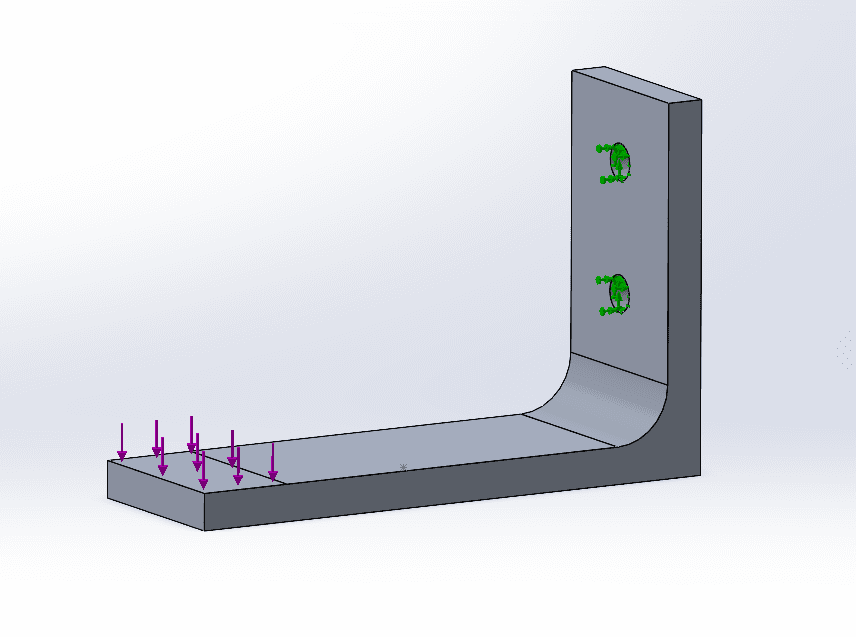
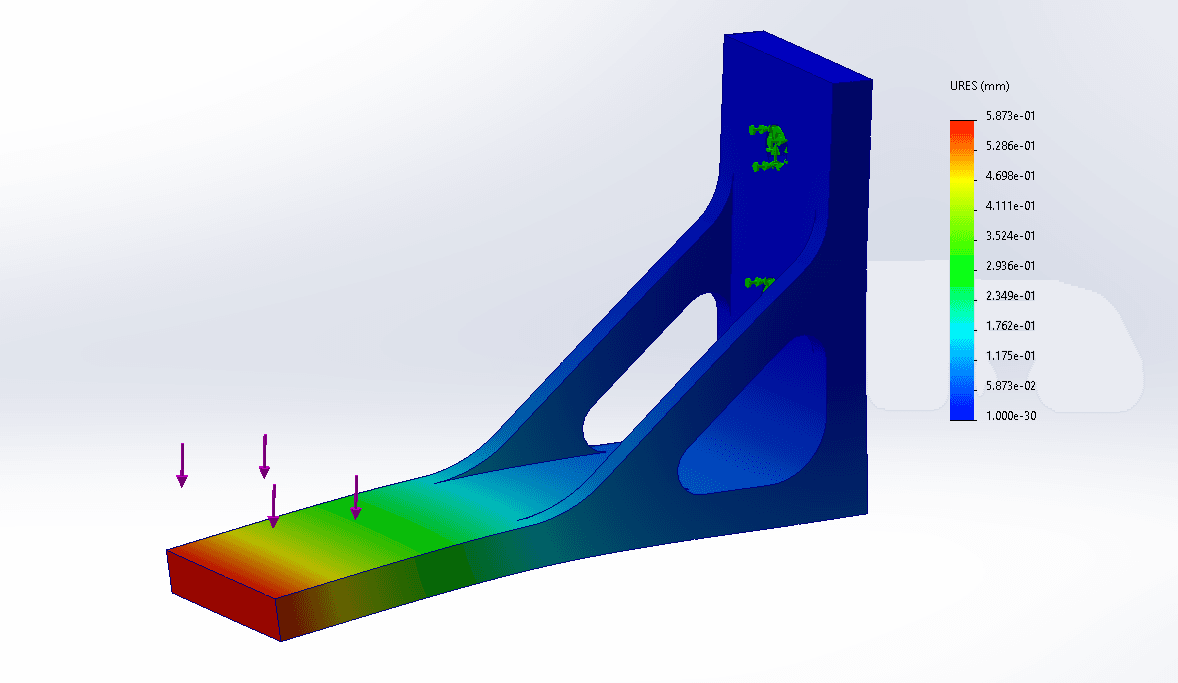
The internal cylindrical surfaces of the two mounting holes were fixed to approximate rigid bolted attachment. A total downward load of 500 N was distributed across a region near the free end of the horizontal arm.
- Applied load: 500 N downward
- Yield strength: approximately 275 MPa
- Fixture: two mounting-hole cylindrical surfaces
- Strength requirement: factor of safety > 2
- Stiffness requirement: maximum displacement < 1 mm
03Baseline design
The initial bracket consisted of a simple L-shaped body with an internal fillet at the transition between the horizontal arm and vertical mounting plate.
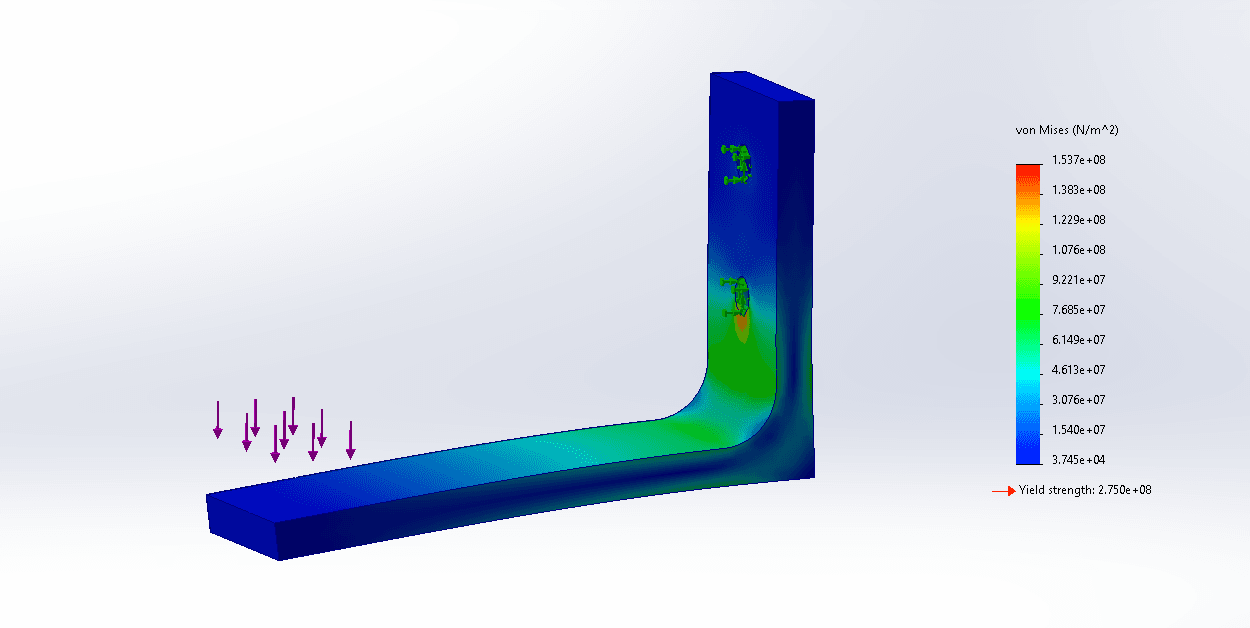
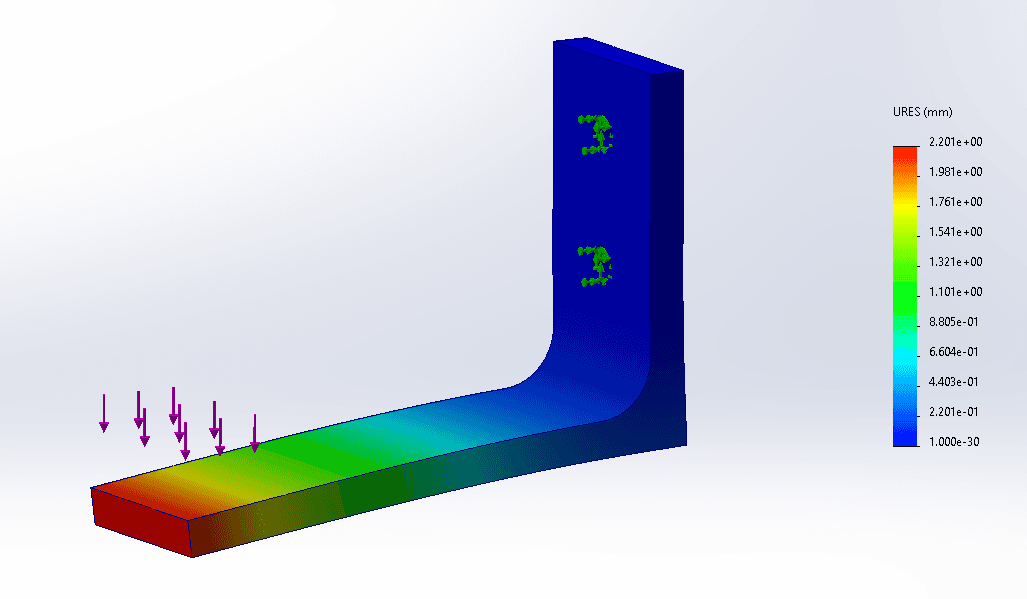
The first simulation showed that the baseline design did not satisfy either structural target. Maximum von Mises stress reached approximately 153.7 MPa and maximum displacement reached 2.201 mm, corresponding to an approximate factor of safety of 1.79.
04Structural redesign
The baseline results showed that the largest bending demand occurred near the fixed end of the bracket. Rather than increasing the thickness of the entire arm, two triangular gussets were added between the horizontal arm and vertical mounting plate to reinforce the high-moment region.
This modification substantially increased stiffness and reduced stress while adding material only where it contributed directly to the load path.
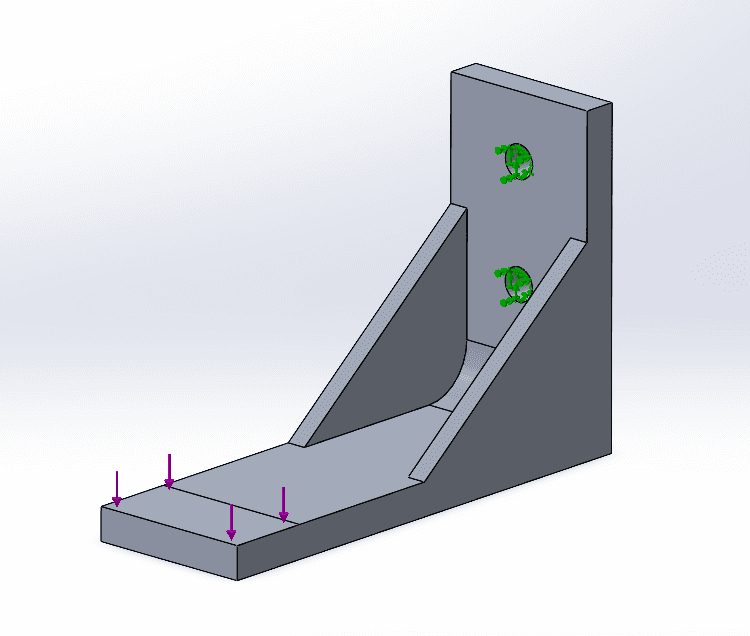
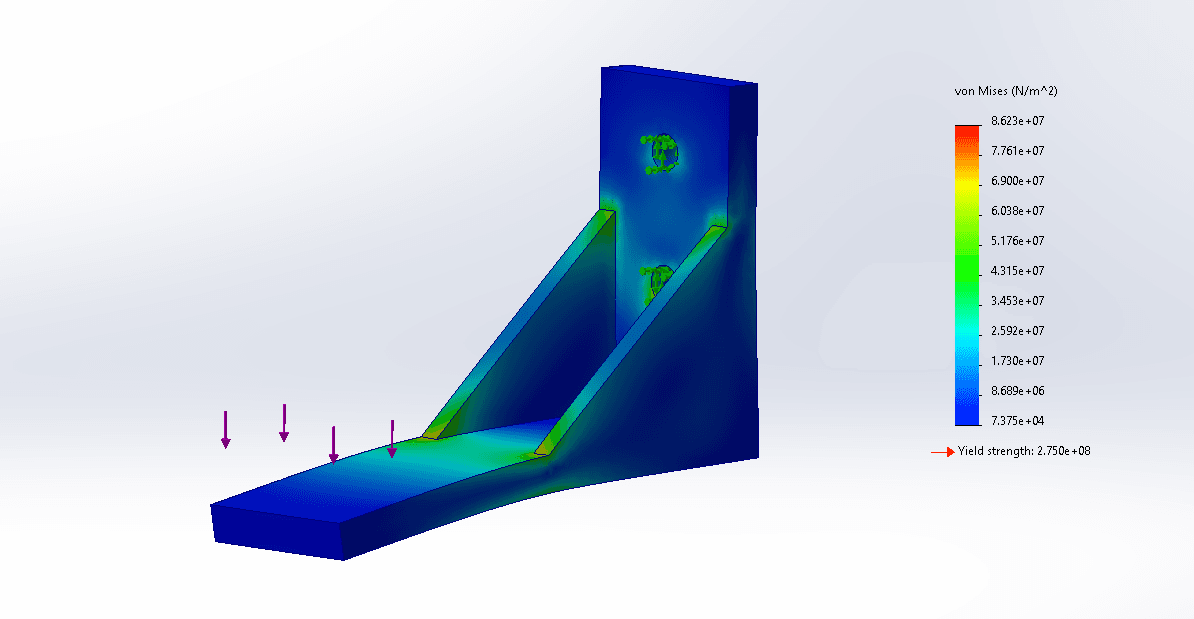
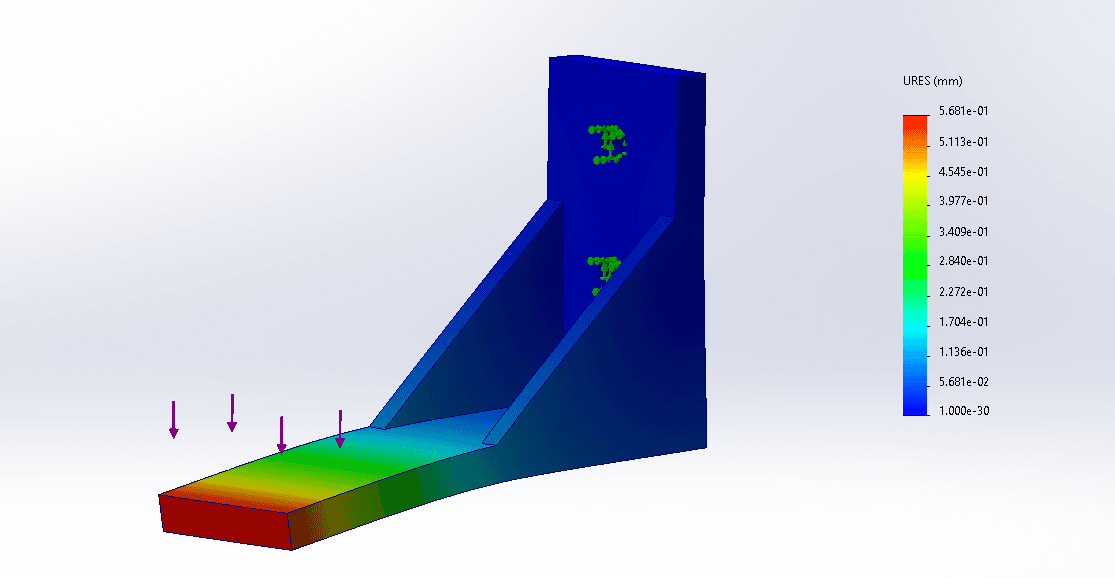
The solid-gusset design increased the factor of safety to approximately 3.19 and reduced displacement below the 1 mm requirement, but mass increased from 326.28 g to 380.00 g.
05Mass optimization
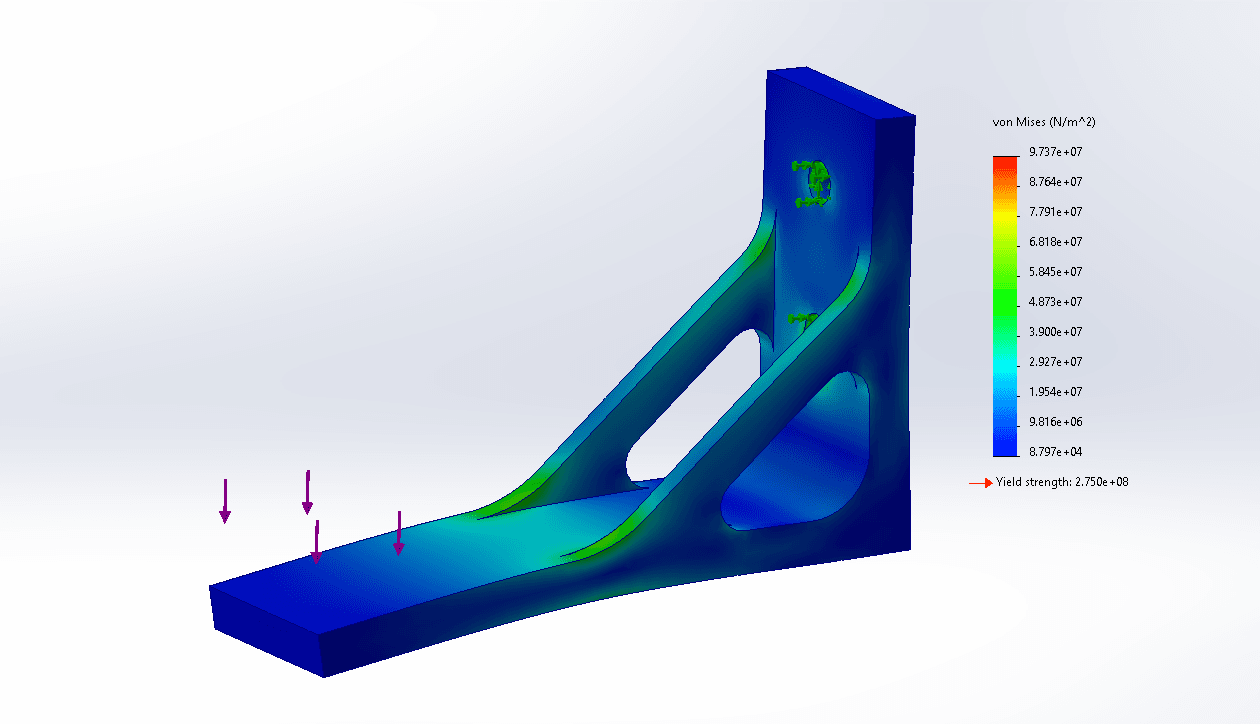
Because the solid-gusset design exceeded both structural requirements by a comfortable margin, a second iteration removed material from the central regions of the gussets while maintaining continuous load paths around their perimeter.
The pocketed design reduced the mass of the reinforced bracket while retaining sufficient stiffness and strength.
06Results
- Baseline mass
- 326.28 g
- Baseline stress
- 153.7 MPa
- Baseline displacement
- 2.201 mm
- Baseline FOS
- 1.79
- Solid-gusset mass
- 380.00 g
- Solid-gusset stress
- 86.23 MPa
- Solid-gusset displacement
- 0.568 mm
- Solid-gusset FOS
- 3.19
- Final mass
- 353.66 g
- Final stress
- 97.37 MPa
- Final displacement
- 0.587 mm
- Final FOS
- 2.82
07Design outcome
The final design satisfied both structural requirements with a factor of safety of approximately 2.82 and maximum displacement of 0.587 mm.
Compared with the baseline, maximum stress was reduced by approximately 37% and displacement by approximately 73%. The final design required approximately 8.4% more mass than the original bracket, but converted a design that failed both structural requirements into one that met both with margin.
Pocketing the gussets removed approximately 26.3 g, or 6.9%, from the solid-gusset version while producing only a small increase in stress and displacement.
08Takeaways
The analysis demonstrated the value of placing material according to the load path rather than increasing thickness uniformly. Reinforcing the root of the cantilever with gussets produced a large improvement in stiffness and stress distribution for a relatively small increase in total mass.
The final iteration also demonstrated that structural performance and mass can be balanced through targeted material removal once adequate strength and stiffness have been established.