Robotics · 2023
BREAD 2023 Elevator
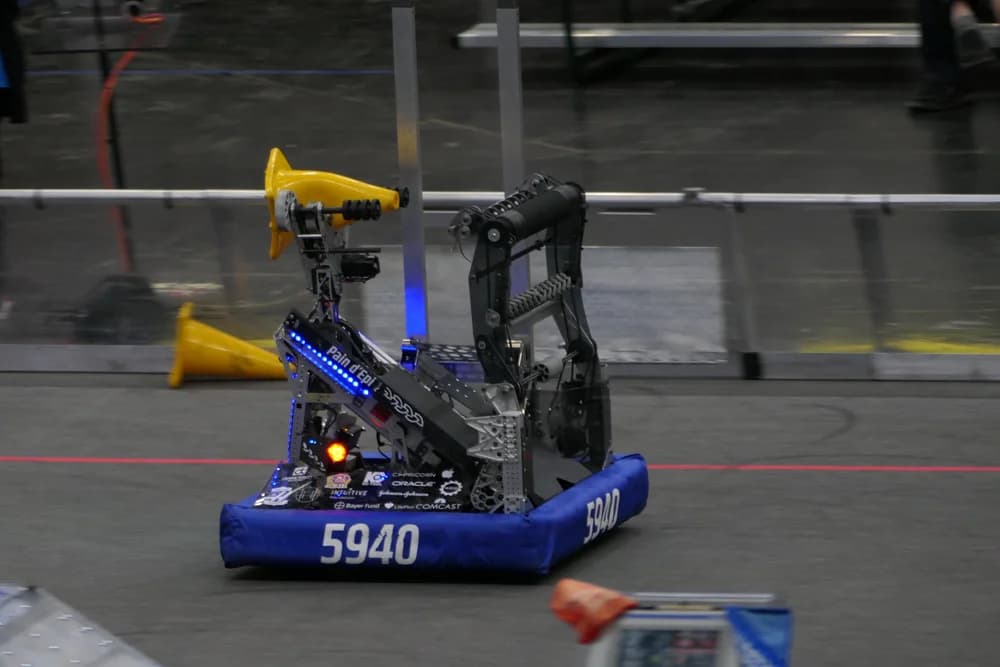
Designed the three-stage slanted elevator for FRC Team 5940's 2023 robot while serving as Mechanical Lead, balancing scoring speed, rigidity, weight, packaging, and competition reliability.
- Role
- Mechanical Lead
- Tools
- Onshape, CNC Machining, 3D Printing, Mechanical Assembly
- Timeline
- 2023 FRC Season
- Team
- FRC Team 5940 — BREAD
01Objective
The elevator served as the robot's primary linear motion stage, translating the end effector diagonally from the floor-intake position to the scoring grid.
The design centered on reducing scoring cycle time while maintaining the rigidity, low weight, packaging efficiency, and reliability required for repeated competition use.
02My role
I served as Mechanical Lead for FRC Team 5940 during the 2023 season and independently designed the elevator subsystem in Onshape. I also contributed to manufacturing, assembly, testing, and integration with the rest of the robot.
- Designed the complete three-stage elevator assembly and stage geometry
- Designed the custom bearing blocks and slide system
- Developed the internal Dyneema rigging and winch architecture
- Designed a revised rope-guiding spool to improve winding reliability
- Iterated the drivetrain to increase elevator speed
- Supported fabrication, assembly, testing, and mechanical integration
- Led mechanical development during the 2023 season
03Architecture
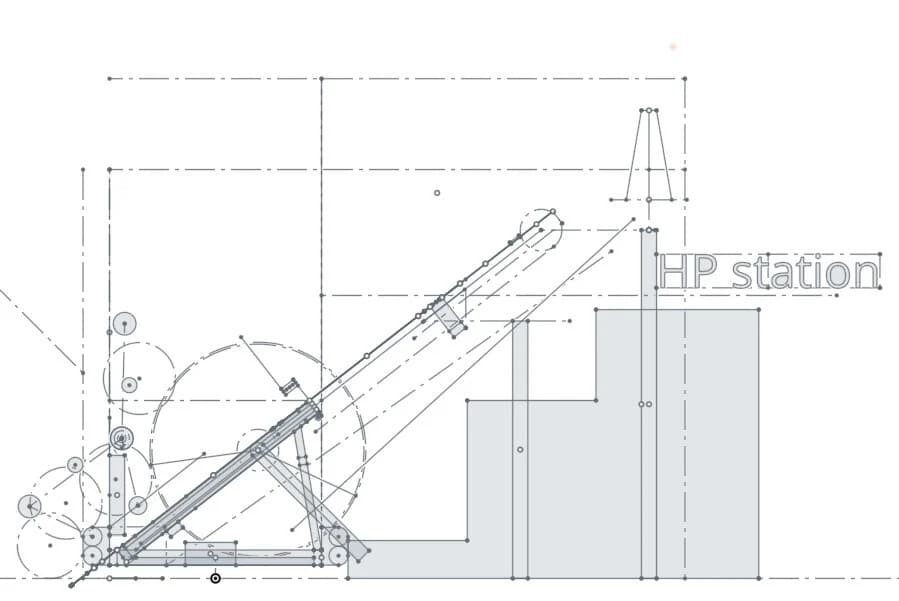
During early architecture development, the team evaluated several approaches including double-jointed arms and telescoping arm concepts. We selected a slanted elevator because it provided a comparatively simple way to achieve the required scoring motion and allowed us to build from an elevator architecture we had previously developed.
The final mechanism consisted of three stages including the fixed base. Custom bearing blocks guided the moving stages, while a continuously rigged Dyneema cable system translated the carriage along the elevator.
Constant-force springs assisted the mechanism through its travel, reducing the effective load on the drive system.
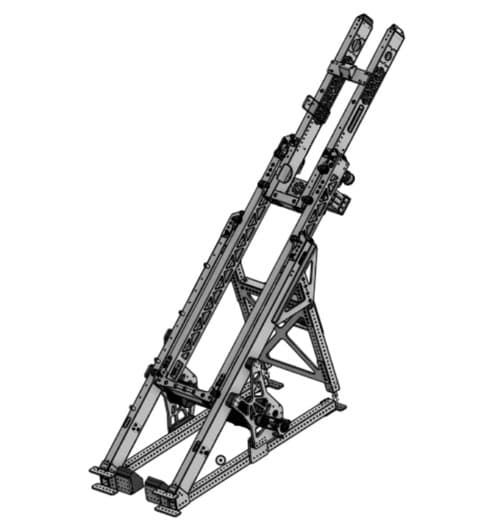
The elevator was integrated into the robot at an angle so that its linear motion closely matched the desired path between intake and scoring positions. The CAD model was used to control stage geometry, bearing placement, cable routing, packaging, and subsystem interfaces before fabrication.
04Custom slide system
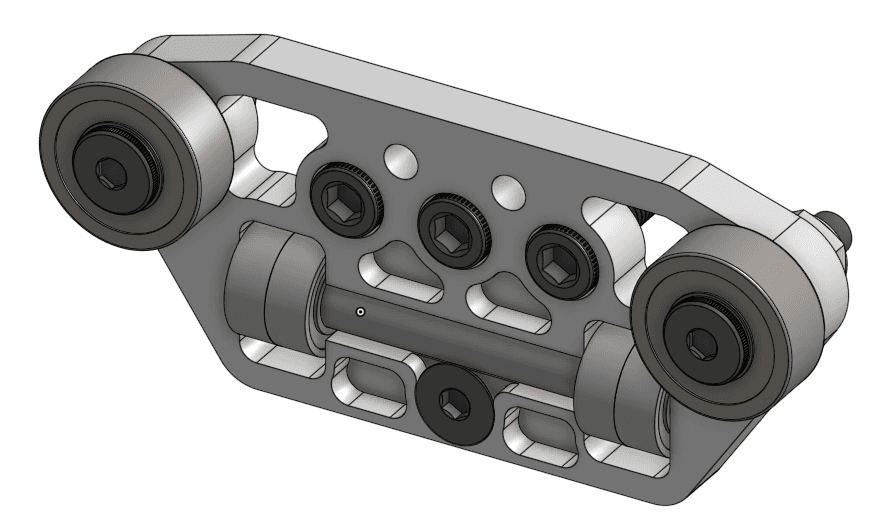
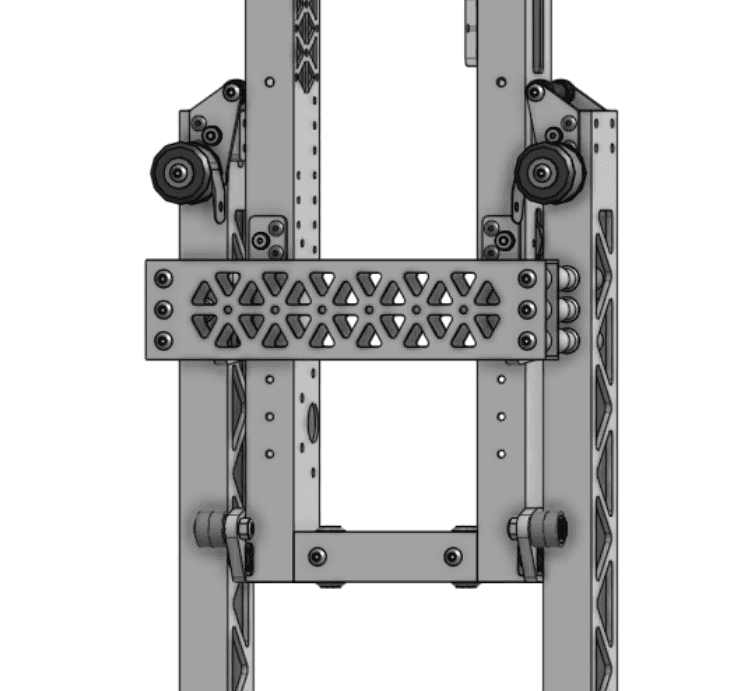
Rather than purchasing commercial elevator bearing assemblies, we fabricated our own bearing blocks. The geometry was inspired by existing FRC bearing-block designs but adapted specifically for our manufacturing capabilities.
The blocks were designed so they could be produced in-house on a router-style CNC using simple tooling. This reduced cost while allowing the geometry to be optimized around the elevator tubes and packaging requirements.
05Cable drive
The competition elevator used a continuously rigged 7/64-inch Dyneema cable rather than the belt drive used on an earlier prototype. Cable provided better packaging, eliminated concerns about belt tooth skipping, and reduced moving rigging mass.
The cable was routed internally through the elevator tubes and attached to the carriage. A spool mounted near the base of the elevator was driven by two Falcon 500 motors through a gearbox.
The initial competition configuration used approximately a 7:1 reduction. After our first event, we identified elevator travel time as an opportunity to reduce the overall scoring cycle and changed the gearing to 5:1 to increase mechanism speed.
06Competition-driven iteration
At our first competition, the Central Valley Regional, the robot experienced several issues and we began looking for opportunities to reduce cycle time and improve overall performance. Elevator travel represented a meaningful portion of the scoring sequence, making it a clear target for optimization.
Along with changing the drivetrain reduction from roughly 7:1 to 5:1, I redesigned the winch spool to address inconsistent Dyneema winding.
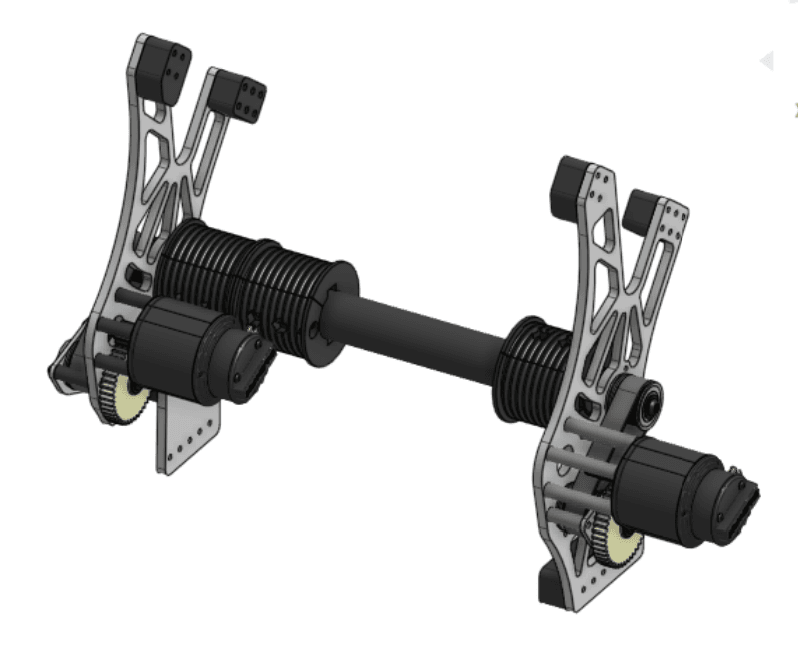
Originally, the Dyneema wound directly onto a hollow aluminum tube. Under repeated operation, the line could overlap and stack inconsistently on the spool.
I designed a 3D-printed spool with a helical groove that positively guided the Dyneema across the drum as it wound. We also adjusted the cable's approach geometry to reduce the fleet angle, helping the line enter the spool more smoothly and reducing the tendency for adjacent wraps to overlap.
Together, the revised spool geometry, improved cable alignment, and faster gearing improved the elevator's consistency while reducing scoring cycle time.
07Design priorities
The elevator was optimized around scoring speed, but speed could not be treated independently. Increasing acceleration and travel speed placed greater demands on the stage rigidity, bearing system, cable routing, gearbox, and overall reliability. The final design represented a balance between mechanism speed, approximately 18 lb of subsystem mass, packaging constraints, and the need to survive a full competition season.
08Gallery
09Results
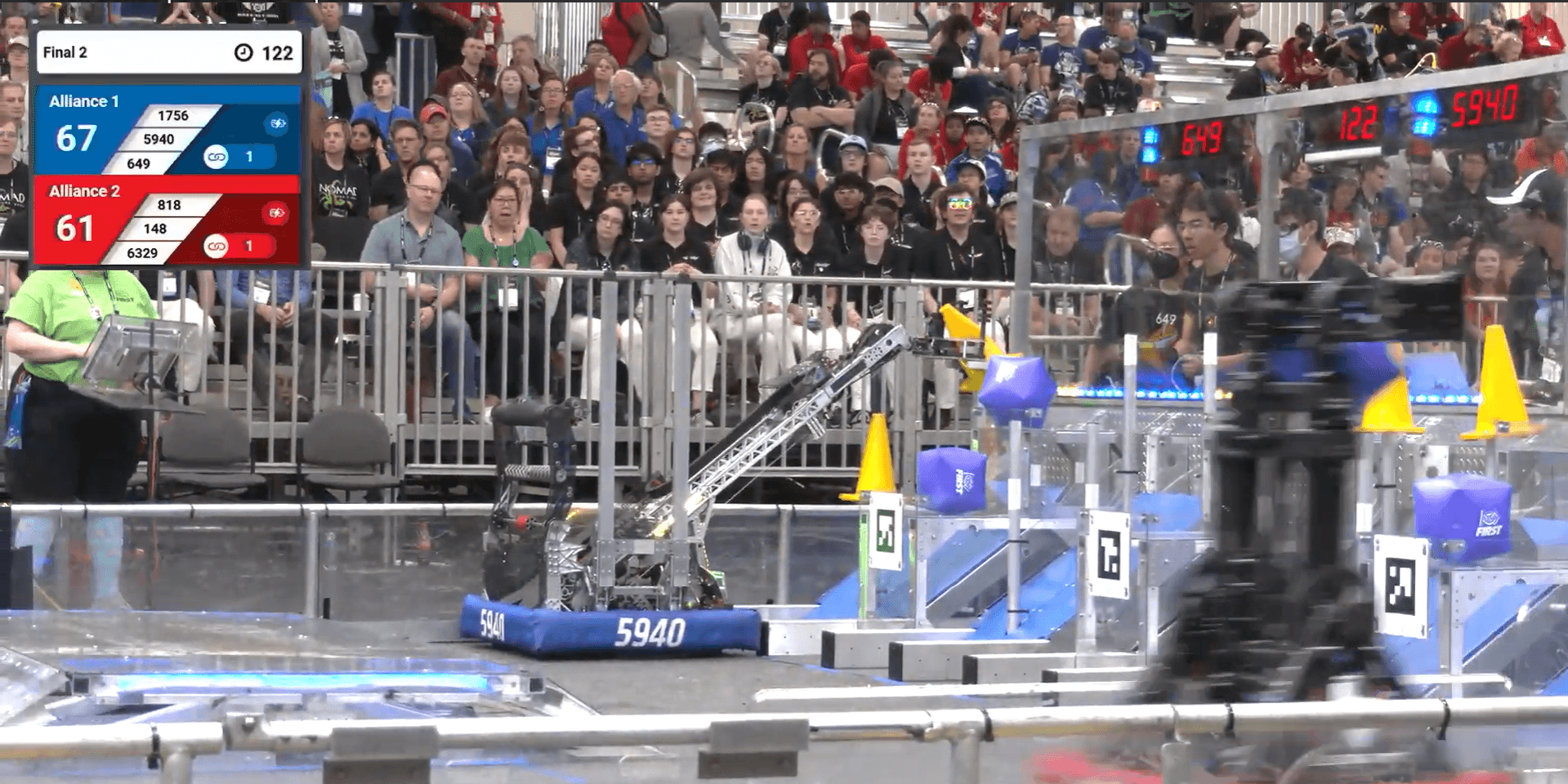
The elevator remained the robot's primary scoring mechanism throughout the season. Team 5940 won the Monterey Bay Regional, ranked first in its division at the FIRST Championship, and advanced to the division finals.
- Stages
- 3 including base
- Drive
- 2 × Falcon 500
- Final reduction
- 5:1
- Rigging
- 7/64 in Dyneema
- Mass
- ~18 lb
- Robot limit
- 120 lb
10Lessons learned
This project reinforced the importance of treating mechanical design as an iterative process rather than considering a subsystem finished once it works.
The Dyneema drive offered excellent packaging and low moving mass, but details such as spool geometry and cable entry angle became critical to reliable operation. Small changes to those interfaces produced meaningful improvements without requiring a complete redesign.
The season also showed me how competition data can guide engineering priorities. After identifying scoring cycle time as a limitation at our first event, we were able to target the elevator drivetrain and rigging directly instead of making changes without a clear performance objective.